
SmartPortos Brasil: Dev. an AI-Powered Smart Port Platform with Assisted-AI & Prompt Engineering
By Railson N. De Arruda - 2026.
The maritime and port sectors are undergoing a profound digital transformation. Modern ports are no longer just logistics hubs—they are becoming connected ecosystems where operational efficiency, environmental compliance, cybersecurity, and real-time decision-making depend on data integration and intelligent automation.
Motivated by this challenge, I started developing SmartPortos Brasil, a digital platform designed to centralize environmental, operational, and regulatory information for ports, terminals, vessels, and maritime service providers.
This project was built with the support of Artificial Intelligence tools, combining software engineering principles with environmental engineering expertise and modern development practices.
The Concept Behind SmartPortos Brasil
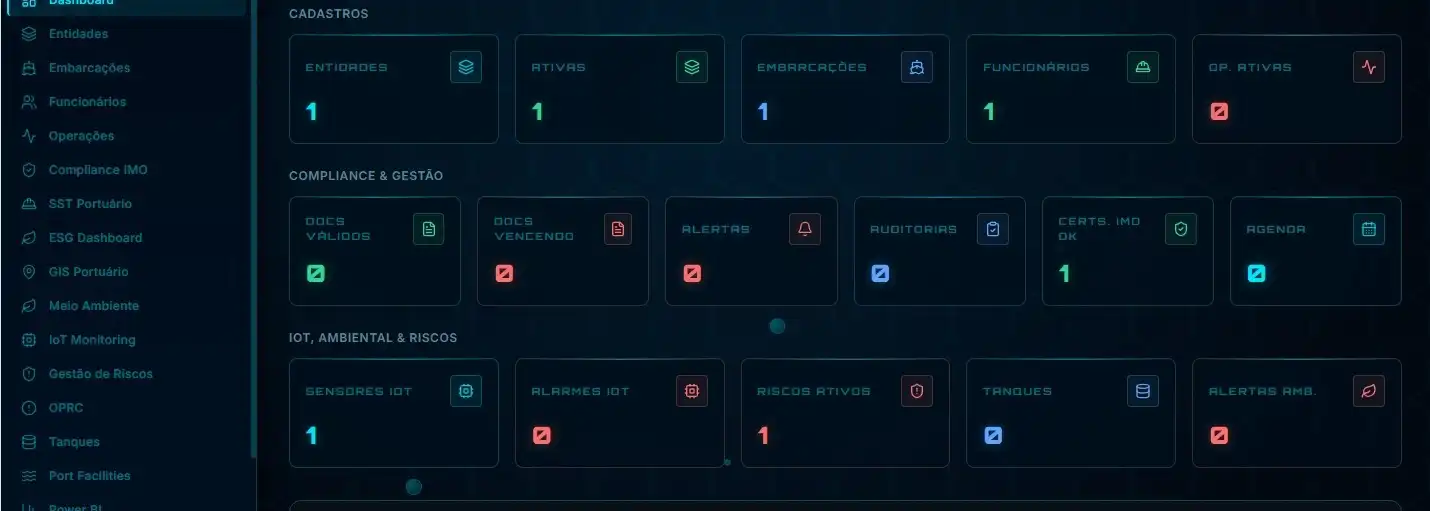
SmartPortos Brasil is a web-based platform designed to integrate multiple operational modules into a single intelligent ecosystem.
Its primary objectives include:
- Environmental management
- ESG monitoring
- Maritime compliance
- GIS visualization
- Vessel monitoring
- IoT integration
- Digital documentation
- AI-assisted decision support
- Technical reporting
- Regulatory management
The goal is to replace fragmented spreadsheets and isolated systems with a centralized digital platform capable of supporting operational and environmental decisions in real time.
Artificial Intelligence as a Development Partner
One of the most interesting aspects of this project was adopting Artificial Intelligence not only as an application feature but also as a software development assistant.
Different AI models contributed throughout the project lifecycle.
ChatGPT
ChatGPT was used for:
- software architecture planning;
- database modeling;
- backend logic design;
- API structuring;
- Python development;
- React component generation;
- debugging;
- documentation;
- prompt engineering;
- technical writing.
Rather than replacing programming knowledge, ChatGPT accelerated problem-solving and software design.
Claude AI
Claude complemented the development process by assisting with:
- large-scale code review;
- architecture refinement;
- project organization;
- optimization suggestions;
- long-form documentation;
- software engineering best practices.
Its ability to analyze larger code contexts proved particularly useful during project structuring.
Visual Studio Code
Visual Studio Code served as the primary development environment.
The IDE enabled efficient project management through:
- integrated terminal;
- Git integration;
- Python extensions;
- React development;
- AI-assisted coding;
- debugging tools;
- Docker support;
- REST API testing.
Combined with AI assistants, VS Code significantly increased development productivity.
Technology Stack
The SmartPortos Brasil platform was designed using a modern full-stack architecture.
Backend
- Python
- FastAPI
- REST APIs
- JWT Authentication
- SQLAlchemy ORM
- PostgreSQL
- Pydantic
- Background Tasks
FastAPI was selected because of its excellent performance, automatic API documentation, and scalability.
Frontend
- React
- Vite
- JavaScript
- HTML5
- CSS3
- Responsive UI
- Dashboard Components
The frontend focuses on interactive dashboards and real-time visualization.
Database
The platform organizes information through multiple integrated entities, including:
- Companies
- Projects
- Environmental Records
- Maritime Operations
- Employees
- GIS Layers
- Reports
- Notifications
- Uploaded Documents
- AI Conversations
This modular structure allows the system to evolve without requiring major architectural changes.
Geographic Information System (GIS)
One of SmartPortos Brasil's core features is GIS integration.
Users can upload:
- Shapefiles
- KML
- GeoJSON
- CSV
- Raster Images
These datasets are displayed on interactive maps to support environmental licensing, monitoring, and spatial analysis.
Future versions will integrate:
- Satellite imagery
- Drone orthomosaics
- NDVI analysis
- LiDAR datasets
- Remote sensing layers
IoT Integration
The platform was designed with Industry 4.0 concepts in mind.
Future IoT modules include:
Environmental Sensors
- Air quality
- Water quality
- Meteorological stations
- Noise monitoring
- Radiation sensors
- Tide monitoring
Industrial Sensors
- Tank level
- Flow meters
- Pressure sensors
- Temperature sensors
- Energy meters
- Fuel consumption
Maritime Devices
- AIS receivers
- GPS trackers
- Weather stations
- Vessel telemetry
- Smart buoys
These devices will communicate through protocols such as:
- MQTT
- HTTP REST
- WebSocket
- LoRaWAN
- NB-IoT
- Modbus TCP/IP
This architecture enables continuous environmental and operational monitoring.
AI Modules
Artificial Intelligence is not limited to software development.
The platform itself is being designed to include intelligent services.
Planned AI modules include:
- Environmental Risk Assessment
- ESG Analytics
- Predictive Maintenance
- Computer Vision
- GeoAI
- Automatic Report Generation
- Regulatory Intelligence
- Environmental Compliance Assistant
- Natural Language Queries
- Predictive Environmental Analytics
These services aim to transform raw operational data into actionable intelligence.
Digital Integration
SmartPortos Brasil is designed as an integration platform.
Future interoperability includes:
- AIS vessel tracking
- Meteorological services
- GIS platforms
- Environmental agencies
- Power BI dashboards
- ERP systems
- SCADA platforms
- IoT gateways
- Cloud storage
- Government databases
This integration reduces manual processes while improving data consistency across multiple stakeholders.
Engineering Meets Artificial Intelligence
Developing SmartPortos Brasil demonstrated that Artificial Intelligence is becoming an essential engineering tool.
Instead of replacing software developers or engineers, AI acts as a productivity multiplier.
Tasks that previously required hours of research, debugging, or documentation can now be completed much faster while allowing engineers to focus on architecture, validation, and innovation.
The combination of Engineering expertise, Python, FastAPI, React, GIS technologies, IoT, and Artificial Intelligence creates opportunities for building digital platforms capable of transforming highly regulated sectors such as ports, mining, infrastructure, energy, and environmental management.
Final Thoughts
SmartPortos Brasil is more than a software project.
It represents a practical application of Digital Transformation, combining software engineering, environmental intelligence, IoT, geospatial technologies, and Artificial Intelligence into a unified platform designed to support the future of smart ports.
As AI continues to evolve, platforms like SmartPortos Brasil illustrate how engineers can leverage intelligent tools not only to write better software but also to create integrated digital ecosystems that improve operational efficiency, environmental sustainability, and strategic decision-making.
Technologies: Python • FastAPI • React • Vite • JavaScript • PostgreSQL • SQLAlchemy • GIS • GeoAI • IoT • REST API • Docker • JWT • VS Code • ChatGPT • Claude AI • Git • ESG • Smart Ports
#Python #FastAPI #React #ArtificialIntelligence #ChatGPT #ClaudeAI #IoT #GIS #GeoAI #SmartPorts #DigitalTransformation #SoftwareEngineering #EnvironmentalEngineering #ESG #Industry40 #MaritimeTech